Pergola Systems Guide: Which System Suits Which Need?
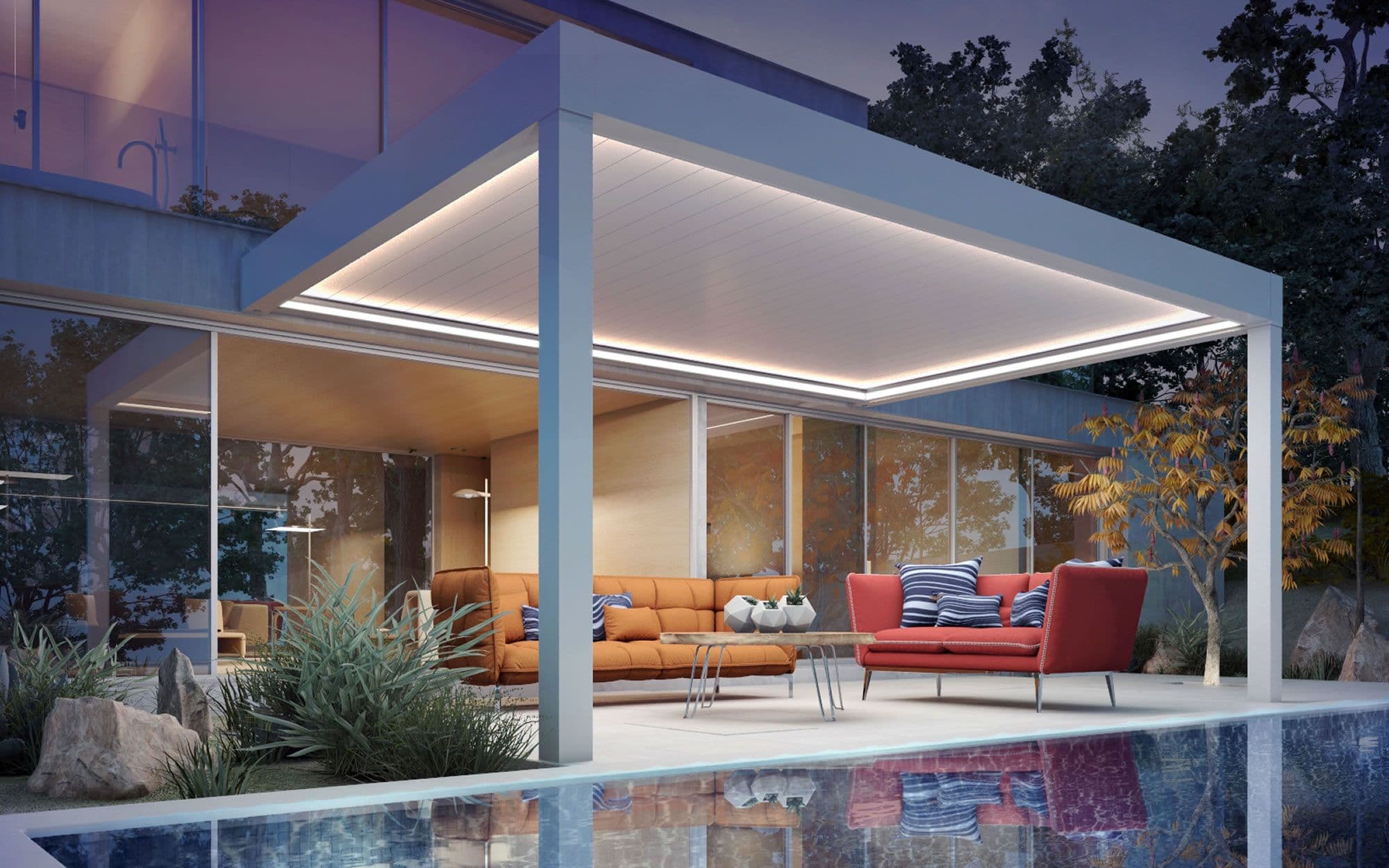
Pergola systems cover an outdoor area to provide shade and protection from the weather. In modern systems the roof is not fixed: bioclimatic models rotate their louvres, rolling roofs open completely, awnings gather fabric. The right choice depends on whether the space will be used in winter.
The One Question That Decides
One question settles most of the decision: will the space be used in winter? If shade and rain protection are enough, pergola systems do the job. If the area will be heated and used through winter, glass systems or a winter garden are required. This split determines both the system and the budget.
In practice people search for a product name first and then try to work out whether it suits them. That is the wrong order and usually ends in a system that is either more expensive than needed or not up to the job.
Answering the three questions below in order narrows the options quickly and makes the rest of the decision straightforward.
- Are you covering the top of the space, the sides, or both?
- Will it be heated and used in winter, or only seasonally?
- Does it matter that the sky can be fully exposed?
Systems That Cover from Above
Three systems cover the space overhead: bioclimatic pergolas, rolling roofs and motorised awnings. The difference between them is how the roof moves. A bioclimatic pergola rotates its louvres in place, a rolling roof slides them aside to open the roof entirely, and an awning gathers fabric by motor.
Bioclimatic Pergola
The aluminium louvres rotate between 0 and 105 degrees. Open, they let air and light through; closed, they interlock into a watertight surface. In the closed position the system withstands 120 km/h wind and a 150 kg/m² snow load.
What sets this system apart is that the amount of shade is adjustable without steps. Fitted with a rain sensor it closes at the first drops, even when nobody is home.
Rolling Roof
The louvres slide along a rail and stack, opening the roof completely. This is the one thing a bioclimatic pergola cannot do: fully exposed sky. Closed, EPDM seals give full water tightness and it carries a 100 kg/m² snow load.
A single span reaches 6 metres and projection reaches 7 metres. If open sky is not a priority, a bioclimatic pergola is usually the better and more economical choice.
Motorised Pergola Awning
The roof covering is fabric, gathered by motor. It is the most economical of the three and blocks 95-99% of UV radiation. With waterproof membrane it also provides rain protection.
Its limit is wind: 60-80 km/h with the awning open and 100 km/h closed. In exposed locations a wind sensor is close to essential.
Systems That Close the Sides
There are two routes for closing the sides: glass systems and zip screens. Glass systems can provide thermal insulation and make the space usable in winter. Zip screens are noticeably more economical, blocking sun and wind but providing no thermal insulation.
Guillotine Glass
Glass panels move vertically. Because no panel stacks to one side, the opening is left completely clear when open. Panel height reaches 3.5 metres and width 100 centimetres.
With double glazing the thermal value drops to 1.1 W/m²K and the space can be heated and used through winter.
Sliding Glass
Panels slide horizontally on rails. Unlike hinged systems they need no swing clearance, so they preserve usable space on narrow balconies. They allow partial opening, but the panels occupy space at one end when open.
Zip Screen
Zipped guide rails on both edges of the fabric keep it permanently taut. That is the difference from a conventional blind: it does not flap in wind, cannot leave the track, and blocks insects at the sides.
Because it provides no thermal insulation it is not enough on its own if winter use is the goal; it can, however, be combined with glass systems.
System Comparison Table
The table below compares five systems against the same criteria. Read it with one thing in mind: these systems are as much complementary as they are alternatives. The most common installation is a bioclimatic pergola above with zip screens or glass at the sides.
The cost column is a relative ranking, not a price. Actual cost varies noticeably with size, profile section, automation level and installation conditions.
| System | Rain | Insulation | Open sky | Relative cost |
|---|---|---|---|---|
| Bioclimatic pergola | Full when closed | None | No | High |
| Rolling roof | Full when closed | None | Yes | High |
| Motorised awning | Depends on fabric | None | Yes | Medium |
| Guillotine / sliding glass | Full | With double glazing | — | Medium-high |
| Zip screen | Partial | None | — | Low |
What to Look for in Materials
Three things determine durability in pergola systems: the aluminium alloy, the profile wall thickness and the surface finish. In quality systems the structural profile is 6063-T6 extruded aluminium, wall thickness is 2.5-4 mm, and the surface is powder coated at 80-100 microns.
Asking about these five items one by one is the fastest way to understand where a price difference between quotes comes from. A one-millimetre difference in wall thickness between two systems that look identical means a real difference in wind resistance.
- Alloy: 6063-T6 is standard for structural profiles, 6063-T5 for glass system profiles
- Wall thickness: 2-2.5 mm is economical, 3-4 mm is the heavy-duty profile
- Finish: electrostatic powder coating, 80-100 microns, UV resistant
- Moving parts: stainless steel and maintenance-free bearings, no periodic lubrication
- Documentation: CE certification and a project-specific structural report should be requested
Is Automation Really Necessary?
Automation looks like a comfort item but its real function is damage prevention. A rain sensor closes the system when nobody is home; a wind sensor moves the louvres or awning to a safe position above a set speed. These two sensors directly extend the life of the system.
Rain Sensor
Closes the system at the first drops. It is the most useful addition in holiday homes and houses left empty during the day; the damage it prevents to furniture and flooring often covers its cost in one event.
Wind Sensor
Close to essential on motorised awnings, where the open-position wind resistance is 60-80 km/h. On a bioclimatic pergola it moves the louvres to the closed position and brings the system into its 120 km/h range.
Remote and App
An RF remote is standard. Smartphone control and Google Home, Alexa or Apple HomeKit integration require an additional module. For daily use a wall switch is enough for most people.
Planning Permission
Demountable pergolas and glass systems usually do not require planning permission. However, site management rules, zoning status and the nature of the property all matter. The picture changes if an enclosed, insulated volume is created; a winter garden may count as enclosed floor area.
For commercial installations and homes inside managed developments, checking with the municipality and the management before starting is the safest route. This check can be made together during the survey.
Maintenance and Running Costs
Aluminium systems need little maintenance. The mechanism runs on maintenance-free bearings and needs no periodic lubrication. Cleaning the louvres, rails and gutter with water once a year is enough in most installations.
On the running-cost side, motor consumption is negligible; tubular motors run only briefly during movement. The real cost item is the early parts replacement caused by neglected maintenance.
- Gutters and drainage: clear leaves and debris once a year
- Glass system rails: clean once a year — dirt is the most common cause of a stiff panel
- Seals: visual check; a worn seal is the main source of noise and leaks
- Coastal installations: rinse twice a year because of salt build-up
Conclusion
Choosing a pergola system starts from the need, not the product name. If the space will be used in winter, glass systems or a winter garden point the way; if shade and rain protection are enough, a bioclimatic pergola does; if open sky matters, a rolling roof.
A firm decision needs an on-site measurement: span, ground conditions and local wind load change both the system choice and the profile section. Site survey and design are free across central Antalya and the surrounding districts.